Angel Fish
Pet January 12th, 2006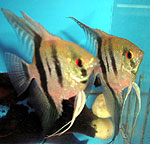
Common Name: Angel Fish
Size: up to 6" (15cm)
Tank: 48 inches
Strata: Middle
pH: 5.0 to 7.5
Hardness: Soft to medium.
dH range: 1-20
Temperature: 73ºF to 84ºF (23-29°C)
General Body Form:
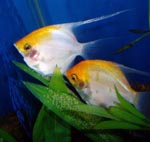
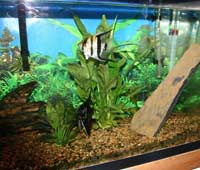
Disk-shaped. Angel fish’s Dorsal and Anal fins Are elongated and sail-like, the Pectoral fins are stretched into long filaments. The Caudal fin is fan shaped and broad. The outermost fin rays are prolonged. In older Angel fish the forehead bulges. Including the fins the Angel fish may reach a length of six inches and a height of ten inches.
Tank Size:
The minimum size tank for a breeding pair of Angel fish is 15 gallons, but should be 25 gallons or larger if you plan on leaving the fry with the parents. As you can imagine, a fully grown pair of Angel fish with 200-300 fry to herd around would be pretty cramped in anything smaller. Another plus to having a larger tank is that there is a better feeling of security in a larger tank and the Angel fish parents aren’t as apt to eat their eggs or young.
Diet:
Angelfish can survive on flake food alone, but they will thrive and be much more apt to breed on a greatly varied diet. Live foods such as Adult Brine Shrimp, Black Worms, Mosquito larvae, finely chopped earthworms and Guppy fry are accepted with enthusiasm and should be included regularly. If live food is not available, frozen packages of Blood Worms (Midge Fly larvae), Brine Shrimp and others are available from your favorite pet supply store and are acceptable substitutions for the live food. There are many dried foods available that will suffice too. Raw beef heart, finely ground, mixed with unflavored gelatin and frozen immediately in small one serving size pieces is a good and economical addition to your Angelfish diet. Be absolutely sure there is no fat in the meat.
Choosing Breeder Angelfish:
The best way of assuring yourself at least one young pair is to choose 6 perfect specimens from a large tankful of young angel fishes. This method is less expensive than buying proven angel fishe breeders that may be near the end of their breeding careers anyway. When preparing to buy 6 Angel fish, take your time to study the angel fish and select only those with straight top and bottom fins and perfect ‘feelers’ without any bowing or bends in them. Angel fish should be strong, robust and active. Angel fish that are active feeders mean they will grow quickly, and have a high rate of egg production in the females. Do not buy Angel fish from a tank with either dead fish in it, with fungus or parasite infestations. Resist the urge to ‘come to the rescue of the little ugly duckling’ because it will only grow up to be a big ugly duckling and will be totally unsuitable for breeding purposes. Be extremely picky with your breeder selection and you will be rewarded with beautiful fry. Once you have carefully selected your 6 potential Angel fish breeders, they can be set up in a 20 gallon tank minimum to grow up in and to finally pair off. If Angel fish are fed well with a good selection of live foods, they will grow quickly and reach breeder size rapidly. One sure way to acquire a true breeding pair of Angel fish is to purchase a proven pair from a breeder. When you purchase a pair this way there is always the possibility that they are at the end of their breeding career.
Spawning:
In mature Angel fish, breeding can be stimulated by a partial water change and a rise in temperature to between 80 and 82 degrees F. One sure sign that spawning is about to occur is the appearance of the pair’s genital papillae. These look like little nipple-like projections and are called ovipositors (oh vi poz’ uh turs), a word that literally means "egg-placer(s)". The female’s ovipositor is larger and more blunt than the male’s which is slender and more pointed. These protuberances which appear at the vent are used respectively for depositing eggs and fertilizing them. The obvious differences in the genital papillae are the first completely reliable indication of sex determination. The Angel fish pair will select a spawning site and thoroughly clean it about two or three days before actual spawning takes place. When the cleanliness of the spawning site finally meets the approval of the parent fish, the female Angel fish will make a few test runs. She will pull her ventral fins or feelers close to the lower sides of her abdomen and her anal fin will be situated so that her entire lower line is relatively straight. Her ovipositor will then be able to make full contact with the slate, leaf or whatever was chosen for a spawning site. The male Angel fish will then make a few practice runs too before the actual spawning takes place. When spawning actually takes place, the female will pass over the site and eggs are deposited which adhere to the surface. The male then moves in and scoots along over the string of eggs just laid and fertilizes them, his fins taking the same position as the female’s so he can press closely to insure a higher fertilization rate. The male and female Angelfish will take turns making passes over the spawning site until several hundred or more eggs have been laid, depending on the size and condition of the female prior to spawning. The parents will hover closely over the spawn and fan continuously with their pectoral fins to create a circulation of water over and around the eggs. Some unfertilized eggs will turn white in a matter of hours and will be removed by the parents.
Source: Badman’s Tropical Fish
September 20th, 2010 at 11:30 am
Should the pairing tank with the juveniles be a bare-bottom? what should i put in it?
September 20th, 2010 at 3:37 pm
yes it’s their characteristic. but when they feel threaten they will eat their own fry.
November 5th, 2010 at 1:55 pm
I got lucky and got a pair out of two baby angels. I bought a little gold female when she was about the size of a quarter I named her Gabby. Not sure how but I knew she was a female. My ex then bought be a beautiful altium. He as the boss of the tank at the store and was about the size of a silver dollar. Because of his wonderful marking and his personality of showing off he earned his name of elvis. As soon as I put Elvis in the tank gabby (who was about 3 months old) Got all excited and followed him around. He seemed to be paitent with the smaller angel and even got a little panicky when he looked back and she had not followed. I was at best hoping for two females but as it turned out about two weeks ago they paired off and laid eggs. I quickly got a tank divider but it was too small for my 55 even though it stated it was able to fit my tank. I ended up having to crowd them into a corner of the tank with their plant that had the ggs and a smooth rock. The eggs hatched and became wrigglers but sadly within 3 days they were eaten. Before the divider they were being very good parents , I think the divider just upset them. A day ago I noticed new eggs and panicked, this time I was going to do it right. I could not find a divider that would work so I had to move them into the 20 I had set up for my kribensis/ I took the kribensis and placed them in the 55 gal. I then dranked the 20 almost all the way and filled it with water from the 55 gallon. I then filled a bucket with the 55 water and carefully placed the spawning area in the bucket. I transfered this to the 20 then the parents. They have so far ate all but two of the eggs. I believe this is because I moved them.
I was wondering if the likely hood of them breeding again in two weeks was strong? They seem to be adjusting to the new tank perfectly Elvis is even trying to get Gabby to breed again but she has no more eggs for a while. I have plans of removing the parents back into the 55 once the fry are free swimming. Is this a good idea? What can I do to get them as adjusted to the new tank as they were in the 55? Will being put in a smaller tank after such a large tank affect their breeding? Any help would be greatly appreciated. Thank you
November 5th, 2010 at 1:59 pm
Also… Should the tank be bare bottom? Both of my tanks have gravel, top of the line filters, air stones, a piece of drift wood, and several plastic and cloth plants. I had to put a large dragon in the 20 because they chose the largest decoration in the 55 to breed on.
May 8th, 2011 at 5:11 am
hi i have a breeding pair they are about year and a half they have had several batches off eggs that have got the fry last untill they were 8 days old but they all die. the last time they ate them as soon as they were wrigglers because they couldnt keep them on the leaf they got sick of sticking them back on lol. this time i was worried though as my female only laid about 50 eggs was very sloppy this time ware she put them AND even after the male fertilized them and he did a fab job, i was left with 23 by this morning and now by the night i am now left with 13 wigglers ??? ware they all gone and also why are they laying such less and fertilizing less ?? any advise would be fab thankyou
May 10th, 2011 at 4:42 pm
whenever ur angel fish lay eggs, do not disturb ur fish and do not go near your tank.
else your fish will think that u r the intruders and they will try to protect their child by eating them.
Experience breeder told me that you need to cover your tank with newspaper for few weeks when your angel fish lay eggs to prevent them being shocked. and this way you will have all ur small fishes grow big 🙂
March 18th, 2012 at 11:58 pm
hi i have to breeding angle fish that breed all the time. i have them in a 55 gallon tank. the fourth time they bred they actually let them get to the begging to to fry stage. i had a couple of fish in the tank when they were breeding but slowly i have removed all the other fish and now one of the fish is beating the other fish almost to death after the eggs are laid. so i tried takeing one out and the other fish just ate the eggs. well i reunited them and a week later they had eggs again and the same thing happened. can you tell me whats going on or what i can do to stop it and let them actually raise their fish
April 5th, 2013 at 12:03 pm
Hi, please help… about 4 days ago, my angels had eggs for the first time. I kept bothering the and now they ate there own eggs, exept for a few. After THAT, i moved the eggs out of the big tank and put them in a 2 gallon. the water got a little cold, so i turned on a heat lamp, and pointed it towerd the eggs. its bean 3.5 days and the eggs still havent hached, but they are fertal. here are some questions i have for you.
(1) should i leave the heat lamp on 24/7, or tern it off at night?
(2)dose the little black dots on the eggs mean the fertal?
(3) can i get diffrent colored fry from the same colored parents?
(4) and how many times do they have to breed to make them stop eating there kids?
please help, I don,t know what to do!!!
P.S. please excuse my bad spelling…:/
April 5th, 2013 at 10:18 pm
hi, please help. my angels had eggs, but started eating them so i moved them to a diffrent tank and pointed a heat lamp on them. well i forgot to tern it off and now the water is 90 digreese. should i keep the tempurture like that or keep it in the 80’s because the wigglers are still alive.
thanks for ur help